
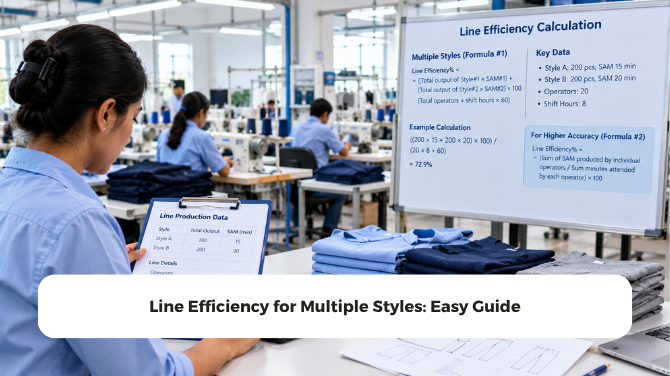
Calculating line efficiency becomes a little more complicated when a garment production line handles two or more styles with different SAM values during the same shift. A simple output-based calculation may not always give you the full picture because each style contributes a different number of standard minutes.
For production teams, industrial engineers, and apparel managers, understanding how to calculate efficiency in this situation helps make daily production performance easier to track and compare.
Question: When a production line runs two or more styles having different SAM, how can I calculate the efficiency of that line per day? … asked by Alamrew Ayalneh
Not only you, but many others find it a problem to calculate line efficiency on the day when one style is going to end, and a new style is loaded to the same line. I am not clear on when you face this problem
- Are multiple styles running on the line at the same time? or
- The previous style is over with some output, and a new style is loaded at the back of the line?
However, I am discussing this issue in detail. I hope you will get the answer to your question from it. There are two ways to find line efficiency,
Formula#1:
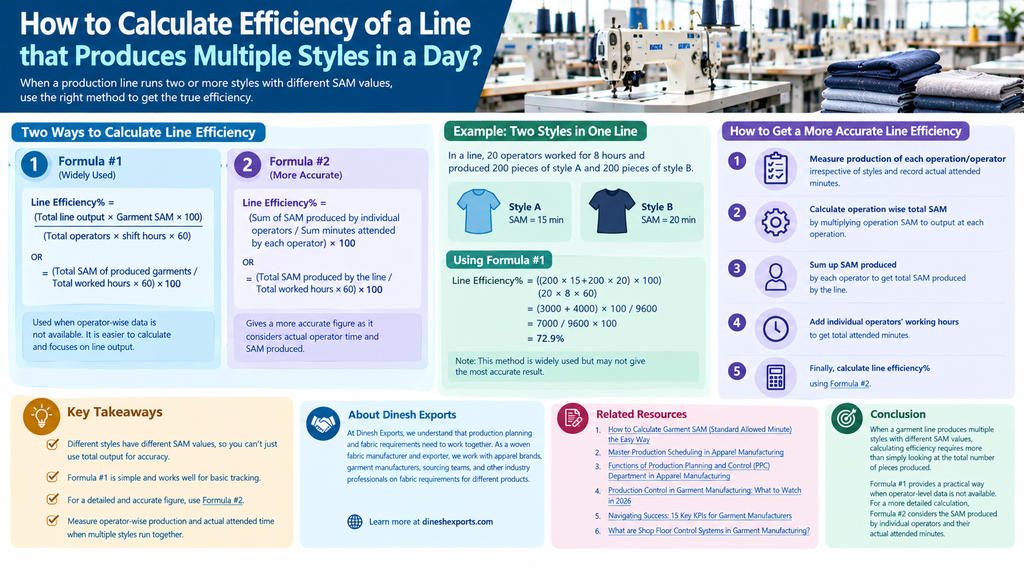
*Line Efficiency% = (Total line output * Garment SAM 100) / (Total operators * shift hours * 60) or
**= (Total SAM of produced garments / Total worked hours60)100
Formula#2:
Line Efficiency% = (Sum of SAM produced by individual operators / Sum of minutes attended by each operator) * 100 or
*= (Total SAM produced by the line/Total worked hours * 60)100
Most of the factories follow formula#1 to calculate line efficiency. As because
i) It is easier to calculate,
ii) Most factories do not have the facility to record operator-wise output (SAM produced) and
iii) the factory is concerned about line output, not about the WIP in the lines.
I have an earlier post on the method of line efficiency calculation using this method. Click here to read it.
Coming to your problem, I guess you use formula#1 to calculate your line efficiency.
Calculating Line Efficiency When Multiple Styles Run Together
When two or more styles are running together in a line. How to use formula#1 to calculate line efficiency? Here is the formula –
*= {(Total output of Style#1 * SAM of style#1) + (Total output of Style#2 * SAM of style#2)}100 / (Total operators * shift hours * 60)
For example: In a line, 20 operators worked for 8 hours, and the line produces 200 pieces of style# A and 200 pieces of style# B. SAM of style# A is 15 minutes, and style# A is 20 minutes.
**Line efficiency %= ((200 * 15 + 200 20)100)/ (20 * 8 * 60)
*= (3000+ 4000)100/9600
*= (7000/9600)100
= 72.9%
Note that though this is a widely used method for line efficiency calculation, you don’t get an accurate efficiency of the line. So, to get an accurate line efficiency figure, use formula#2. You can use this formula for a single style also.
Calculating Accurate Line Efficiency
To calculate line efficiency that runs more than one style you have to measure production of each operation/operator irrespective of styles and measure actual attended minutes by each operator to the work. Then calculate operation wise total produced SAM by multiplying operation SAM to output at each operation.
For example, an operator makes two different operations of two different styles. SAM of operation#1 is 0.50 minute and operation#2 is 1 minute and she made 400 pieces for operation#1 and 200 pieces for operation#2. So Total SAM produced by the operator is equal to 400 minutes (400*0.5 +200 * 1).
Similar way calculate SAM produced by each operator and sum up to calculate total SAM produced by the line. Calculate the sum of individual operators working hours.
Finally, calculate line efficiency% by using formula#2.
Related Resources
If you are working with garment production planning, SAM, capacity, and efficiency calculations, these related Dinesh Exports articles can help you explore the topic further:
- How to Calculate Garment SAM (Standard Allowed Minute) the Easy Way
Understand how SAM is calculated and how it is used for efficiency, costing, line balancing, and production planning. Read the Garment SAM guide - Master Production Scheduling in Apparel Manufacturing
Learn how production capacity, SAM, line efficiency, operators, and working hours are considered when scheduling apparel production. Read the MPS guide - Functions of Production Planning and Control (PPC) Department in Apparel Manufacturing
Explore how production planning and control supports resources, production schedules, and timely manufacturing. Read the PPC guide - Production Control in Garment Manufacturing: What to Watch in 2026
Learn about production control, flexible line planning, efficiency tracking, and common production issues. Read the production control guide - Navigating Success: 15 Key KPIs for Garment Manufacturers
Explore important garment manufacturing KPIs covering productivity, cycle time, WIP, lead time, machine downtime, and more. Read the garment manufacturing KPI guide - What are Shop Floor Control Systems in Garment Manufacturing?
Understand how shop floor control systems can monitor production activities, workforce allocation, machine utilization, and quality. Read the shop floor control guide
About Dinesh Exports
At Dinesh Exports, we understand that production planning and fabric requirements need to work together. As a woven fabric manufacturer and exporter, we work with apparel brands, garment manufacturers, sourcing teams, and other industry professionals on fabric requirements for different products.
Our manufacturing infrastructure supports woven fabric production across yarn-dyed, solid-dyed, and printed fabrics, with a range of fabric types and constructions.
You can learn more about our manufacturing capabilities at Dinesh Exports.
Conclusion
When a garment line produces multiple styles with different SAM values, calculating efficiency requires more than simply looking at the total number of pieces produced. You must consider each style’s SAM because different styles contribute different amounts of standard minutes.
Formula#1 provides a practical way to calculate line efficiency when operator-level data is not available. For a more detailed calculation, Formula#2 considers the SAM produced by individual operators and their actual attended minutes.


[…] Line Efficiency for Multiple Styles: Easy Guide […]